
Your entryway sets the tone for your entire home. If you’re searching for ways to elevate your space with statement entryway architecture, you’re likely looking for ideas that go beyond basic decor — concepts that create impact, flow, and lasting first impressions. This article explores how architectural details, layout choices, materials, lighting, and styling elements work together to transform an ordinary entrance into a defining design feature.
We’ve analyzed leading interior design trends, architectural best practices, and real-world layout strategies to ensure the ideas shared here are both visually inspiring and practically achievable. Whether you’re renovating, building from scratch, or simply refining your foyer, you’ll find guidance that balances aesthetics with functionality.
From bold structural accents to subtle spatial enhancements, this guide will help you understand what makes an entryway truly memorable — and how to apply those principles confidently in your own home.
The Art of Arrival: Crafting an Unforgettable First Impression
As you create a striking entryway with bold structural elements that sets the tone for your home, don’t forget to complement that energetic vibe with a designated morning routine corner that inspires productivity throughout your day – for more details, check out our How to Design a Morning Routine Corner That Inspires Productivity.
A grand entrance is more than décor; it is narrative in built form.
Many homeowners assume square footage alone creates impact, yet proportion, light, and materiality quietly shape emotion.
statement entryway architecture aligns ceiling height, sightlines, and threshold transitions so guests feel guided, not overwhelmed.
Consider:
- Layered lighting for depth
- Intentional focal points
- Seamless storage integration
You might wonder, what’s next? Think about acoustics, scent, and seasonal adaptability.
Some argue minimal entries are safer, but restraint without purpose feels forgettable.
Design your threshold to echo the rooms beyond, creating daily anticipation.
The Foundation: Mastering Light, Scale, and Flow
Great design begins with light, proportion, and movement—the invisible forces that shape how a home feels the moment you step inside.
Harnessing Natural Light
Natural light isn’t just illumination; it’s mood architecture. Transom windows (horizontal windows above doors), sidelights, and glass-paneled doors pull daylight deep into the entry. The benefit? Spaces feel larger, cleaner, and more welcoming—without adding a single square foot. Studies show natural light can improve mood and productivity (Harvard Health). In contemporary Seoul homes, light acts as a primary material, bouncing off pale walls and uncluttered surfaces for a calm, breathable effect. (Think Parasite’s minimalist interiors—minus the tension.)
The Psychology of Scale
Scale is how size influences emotion. Higher ceilings create drama and aspiration; lower ceilings foster intimacy and comfort. Oversized doors signal importance, while compressed thresholds build anticipation. The payoff is emotional control—you decide whether guests feel awe or ease.
Creating Seamless Flow
Flow relies on “visual pathways,” or the lines your eyes naturally follow. Continuous flooring, aligned sightlines, and subtle architectural cues guide movement intuitively. The result is statement entryway architecture that feels effortless, not forced. When flow works, guests don’t hesitate—they move confidently forward (and that confidence becomes comfort).
A Symphony of Materials: Texture, Color, and Tactility
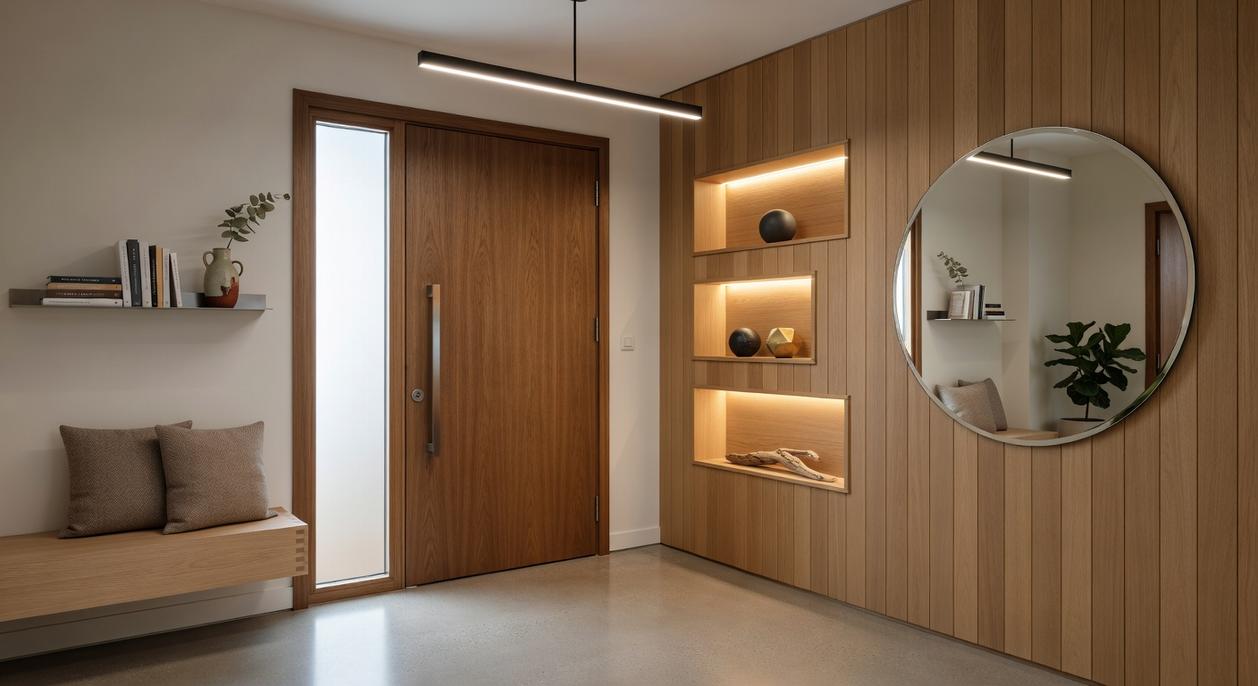
Every unforgettable interior begins with a thoughtful material palette. Start with contrast: the raw honesty of polished concrete and blackened steel set against the organic warmth of white oak or teak. Concrete feels cool and grounded (almost stoic), while natural wood introduces visual warmth and subtle grain movement. This interplay between industrial and organic elements creates tension—in a good way.
That said, I’ll admit there’s ongoing debate about how much contrast is too much. Some designers argue that heavy industrial materials can feel cold or impersonal. They’re not wrong. Without balance, a space can start to resemble a converted warehouse rather than a home. The key is proportion.
Texture is where storytelling deepens. Pair a smooth, large-format tile floor with a hand-troweled plaster wall. Add a sleek metal door handle to a rustic wooden door. These layered surfaces create dimension without visual clutter. Even statement entryway architecture benefits from this approach, where touch becomes part of the first impression.
When it comes to color, move beyond paint swatches. The natural hues of materials—charcoal steel, honeyed oak, creamy limestone—can serve as your primary palette. A monochromatic scheme enriched by varied textures often feels more sophisticated than multiple competing colors (think quiet luxury rather than loud maximalism).
For durability, choose high-quality flooring and solid-core doors that withstand heavy traffic while aging gracefully. Engineered hardwood, porcelain tile, and reinforced steel hardware maintain both function and beauty over time. For more inspiration on spatial harmony, explore blending indoor and outdoor spaces in innovative home layouts.
The Statement Makers: Doors, Lighting, and Focal Points
The front door should feel less like an afterthought and more like a premiere. Think oversized pivot doors that rotate on a central hinge, creating a smooth, gallery-like reveal. Or custom steel-and-glass designs with bronze inlays that catch the light at sunset. When scaled intentionally, a door becomes functional sculpture—both threshold and experience. Many designers stop at paint color; few explore material contrast, thermal performance, and acoustic insulation together (a missed opportunity in high-traffic homes).
The advantage lies in integration, not ornament.
Architectural lighting design is where most entryways quietly fail. A single chandelier, no matter how dramatic, cannot carry the space alone. Layered lighting builds depth and control:
- Integrated LED strips beneath stair treads for a floating effect
- Sculptural pendants in double-height foyers
- Recessed wall washers to emphasize texture
- Sconces that frame art or doorways
This layered approach enhances statement entryway architecture by shaping how shadows move throughout the day. (Think of it as directing a film—light is your cinematographer.)
Every entry needs a focal point. A floating staircase with concealed steel supports. A monolithic stone bench built into the wall. A sightline that pulls your eye straight to a framed garden beyond. Competitors often focus on decor objects; the real power lies in architectural alignment and perspective control.
Styling Tip: Keep accessories minimal. Let material, proportion, and shadow do the storytelling. When light interacts with stone, wood, or glass correctly, you don’t need much else.
From Blueprint to Breathtaking: Your Entryway Transformation
You now have the architectural framework to design an entryway that reflects your home’s character rather than serving as a pass-through. I learned this the hard way. In my first renovation, I treated the entry like leftover space—neutral paint, a small rug, a forgettable light fixture. Guests walked in and felt…nothing. That silence taught me more than praise ever could.
A forgettable entryway suggests a lack of intention. I once blamed square footage, assuming grandeur required space. It doesn’t. It requires clarity. When I began focusing on statement entryway architecture, everything shifted. I studied:
- Light and how it shapes mood
- Scale and proportion in relation to ceiling height
- Materials that echo the rest of the home
- A focal point that anchors the experience
The transformation was immediate. Swap a dim fixture for sculptural lighting, and suddenly the room breathes. Introduce texture—stone, wood, metal—and the space feels layered and alive (like the opening scene of a well-directed film).
Some argue entryways are purely functional. I disagree. Arrival is emotional. Stand in your current space. Identify one element—light, flow, or focal point—you can elevate. Sketch it. Refine it. Begin. Start today.
Elevate Your Space with Confidence
You came here looking for inspiration that feels refined, practical, and achievable—and now you have a clearer vision of how to bring harmony, personality, and purpose into your home. From layout ideas to decor layering and statement entryway architecture, you’ve seen how thoughtful design transforms everyday spaces into intentional environments.
The frustration of rooms that feel unfinished, cluttered, or lacking identity doesn’t have to linger. With the right architectural flow, balanced textures, and cohesive styling choices, your space can finally reflect your lifestyle instead of working against it.
Now it’s time to act. Start by choosing one focal area—whether it’s your entryway, living room, or a key architectural detail—and apply the principles you’ve learned. Explore more curated design concepts and practical styling guides to refine your vision step by step.
If you’re ready to stop second-guessing your decor decisions and create a home that feels elevated and intentional, dive deeper into our expertly curated design resources today. Discover why design enthusiasts trust our insights to turn inspiration into beautifully executed spaces—start transforming your home now.
 Architectural Layout & Styling Consultant
There is a specific skill involved in explaining something clearly — one that is completely separate from actually knowing the subject. Charles Townsendenios has both. They has spent years working with practical home styling tips in a hands-on capacity, and an equal amount of time figuring out how to translate that experience into writing that people with different backgrounds can actually absorb and use.
Charles tends to approach complex subjects — Practical Home Styling Tips, Home Living Highlights, Unique Finds being good examples — by starting with what the reader already knows, then building outward from there rather than dropping them in the deep end. It sounds like a small thing. In practice it makes a significant difference in whether someone finishes the article or abandons it halfway through. They is also good at knowing when to stop — a surprisingly underrated skill. Some writers bury useful information under so many caveats and qualifications that the point disappears. Charles knows where the point is and gets there without too many detours.
The practical effect of all this is that people who read Charles's work tend to come away actually capable of doing something with it. Not just vaguely informed — actually capable. For a writer working in practical home styling tips, that is probably the best possible outcome, and it's the standard Charles holds they's own work to.
Architectural Layout & Styling Consultant
There is a specific skill involved in explaining something clearly — one that is completely separate from actually knowing the subject. Charles Townsendenios has both. They has spent years working with practical home styling tips in a hands-on capacity, and an equal amount of time figuring out how to translate that experience into writing that people with different backgrounds can actually absorb and use.
Charles tends to approach complex subjects — Practical Home Styling Tips, Home Living Highlights, Unique Finds being good examples — by starting with what the reader already knows, then building outward from there rather than dropping them in the deep end. It sounds like a small thing. In practice it makes a significant difference in whether someone finishes the article or abandons it halfway through. They is also good at knowing when to stop — a surprisingly underrated skill. Some writers bury useful information under so many caveats and qualifications that the point disappears. Charles knows where the point is and gets there without too many detours.
The practical effect of all this is that people who read Charles's work tend to come away actually capable of doing something with it. Not just vaguely informed — actually capable. For a writer working in practical home styling tips, that is probably the best possible outcome, and it's the standard Charles holds they's own work to.