I’ve seen too many modern homes with landscapes that completely miss the point.
You spent time getting your architecture right. Clean lines, intentional materials, spaces that breathe. Then you step outside and it all falls apart.
The problem isn’t your plants or your hardscape. It’s that most people treat the landscape like an afterthought instead of what it really is: another room of your home.
I work with design principles that connect indoor and outdoor spaces. The same thinking that makes a modern interior work applies outside too. You just need to know how to translate it.
This article walks you through the framework for creating a landscape that actually fits your modern home. I’ll cover the principles that matter, the materials that work, and the planting strategies that keep things sophisticated without looking sterile.
Landscaping kdarchistyle means understanding that your outdoor space should feel as intentional as your living room. Not cluttered. Not empty. Just right.
You’ll learn how to choose elements that complement your architecture, not compete with it. And how to create outdoor areas that feel cohesive with what’s happening inside your walls.
No generic advice about curb appeal. Just practical guidance for making your landscape an actual extension of your modern home.
The Guiding Principles of Modern Landscape Design
You know what kills most landscape projects?
People try to do too much.
They see a beautiful yard on Pinterest and think they need every element. The water feature. The fire pit. The outdoor kitchen. All the plants they can fit.
Then they end up with a cluttered mess that looks like a garden center exploded.
I learned this the hard way on my first project. I crammed in everything I thought looked cool. The result? It felt chaotic instead of calm.
Here’s what changed everything for me.
Start With Less
Modern landscape design works because it strips away the excess. You’re not trying to fill every square foot. You’re creating breathing room.
Think about it like this. When you walk into a space, your eye needs somewhere to rest. If every corner has something competing for attention, you feel stressed without knowing why.
I worked on a backyard in Bensenville last year. The homeowner wanted to replace their overgrown garden beds. We pulled out about 60% of what was there and left clean stretches of gravel between simple planting zones.
She called me two weeks later just to say how much calmer she felt sitting outside.
That’s the power of negative space. It’s not empty. It’s intentional.
Now, some designers will tell you that minimalism means boring. That you need lots of variety to keep things interesting. And sure, if you take it too far, you might end up with something that feels cold.
But most people never get close to that problem. They’re still dealing with too much stuff, not too little.
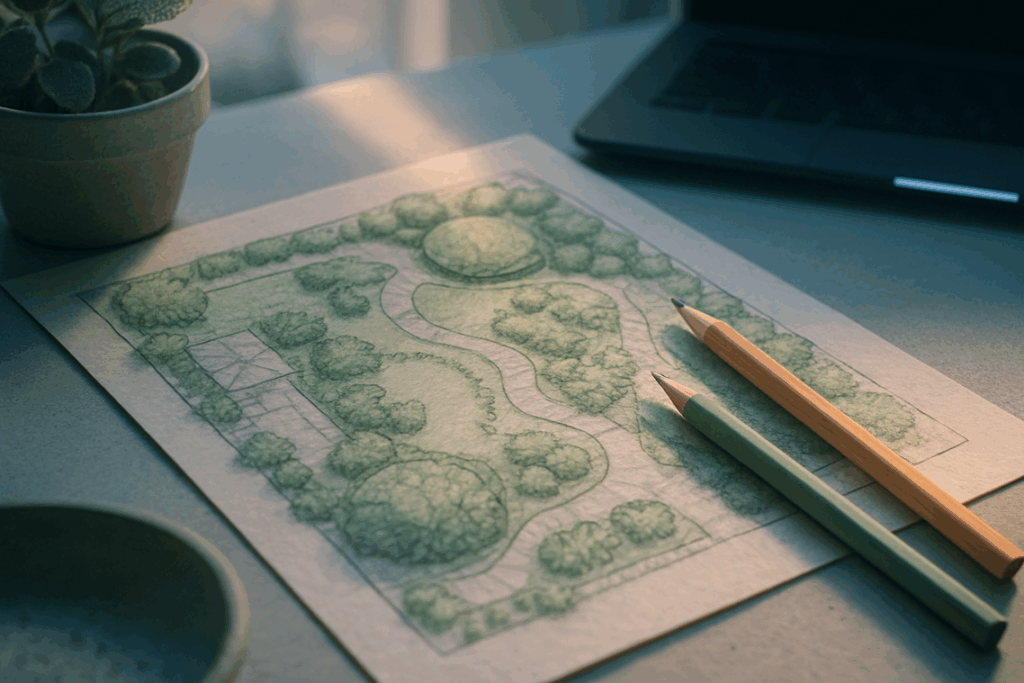
When you’re planning your layout, try this. Sketch out everything you want. Then cut it in half. You’ll probably land somewhere close to right.
Use Lines That Mean Something
Here’s where modern design gets its backbone.
Every line in your landscape should have a purpose. Your pathways shouldn’t meander just because curved feels natural. Your planting beds shouldn’t have wavy edges unless there’s a reason.
I’m talking about clean geometry. Rectangles. Straight runs. Right angles that echo your home’s architecture.
Take a concrete patio. Instead of a random shape, make it a perfect square that aligns with your back door. Run your pavers in a linear pattern that points toward a focal point.
(This is one of those ideas for landscaping Kdarchistyle that actually makes installation easier too. Straight cuts beat custom angles every time.)
One project I remember had a long, narrow side yard. We laid a single line of pavers down the center with identical planting strips on each side. Simple. But it turned an awkward space into something that felt designed.
The trick is committing to the line. Don’t let it wander or soften halfway through.
Match Your House
This one seems obvious until you see how many people ignore it.
Your landscape isn’t separate from your home. It’s an extension of it.
If your house has horizontal siding and a flat roof, your landscape should pick up those horizontal lines. Use low planters. Long benches. Beds that stretch rather than mound.
Got a brick exterior? Bring that material into your hardscaping. Use it for a low wall or as edging for your beds.
I visited a modern farmhouse last month with black window frames and white board and batten siding. The landscape? All warm terracotta pots and curved garden beds. It looked like two different properties.
We swapped the pots for matte black planters and straightened the bed lines. Same plants. Completely different feel.
Pay attention to your color palette too. If your trim is charcoal, don’t use brown mulch. Go with black lava rock or light gravel that creates contrast.
Repeat Yourself on Purpose
You want to know the fastest way to create that designed look?
Pick something and repeat it.
Maybe it’s a specific planter style. Line up five identical black cube planters along your patio edge. Or plant the same ornamental grass every three feet down your property line.
The repetition creates rhythm. Your eye moves from one element to the next and understands the pattern.
I use this with pavers all the time. Instead of mixing sizes and creating a random pattern, I’ll run the same rectangular paver in a stacked bond. It looks intentional because it is.
Here’s a real example. I had a client with a long driveway. We planted the same Japanese maple every 15 feet on one side. Just that one tree, repeated seven times. People always comment on how clean it looks.
The mistake people make is thinking repetition means boring. It doesn’t. It means cohesive.
You can still have variety. But make it controlled. Three different plant types repeated in the same sequence works. Twelve different plants scattered randomly doesn’t.
Try this next time you’re at the nursery. Instead of buying one of everything, buy multiples of a few things you really like.
Your landscape will thank you for it.
Hardscaping: The Architectural Bones of Your Garden
Your garden needs structure before it needs plants.
I see it all the time. People rush to fill their outdoor spaces with flowers and shrubs, then wonder why everything feels scattered.
The truth is simpler than you think.
Hardscaping comes first. It’s the foundation that makes everything else work.
Some designers will tell you hardscaping is just about function. That it’s only there to create paths or hold back soil. They say the real beauty comes from the plants.
But that’s missing the point.
Good hardscaping is what separates a garden from a designed outdoor space. It’s the difference between throwing some pavers down and actually creating something that looks intentional.
Here’s what I’ve learned works.
Concrete as Your Foundation
Large-format architectural slabs give you clean lines. Board-formed concrete adds texture without the fuss.
I use these for patios and walkways because they create a calm backdrop. Your eye can rest instead of jumping around.
Retaining walls in poured concrete? They anchor the whole space.
Wood Brings It Back to Earth
Ipe and cedar are my go-to materials when a space feels too cold.
Linear decks work because they’re simple. Built-in benches give you seating without cluttering the space with furniture. Privacy screens in wood slats let light through while blocking sightlines (your neighbors don’t need to see everything).
High-quality composite decking lasts longer if you don’t want the maintenance. It’s not cheating. It’s being realistic about your time.
Metal for Definition
Corten steel planters age well. That rust patina actually gets better over time.
Powder-coated aluminum edging keeps your beds crisp. Stainless steel works for sculptural moments when you want something to catch the light.
I keep metal accents minimal. Too much and your garden starts looking like an industrial park.
Ground Cover That Actually Works
Here’s where texture happens:
- Black basalt gravel under specimen plants
- Mexican beach pebbles for dry creek beds
- Decomposed granite for pathways that feel softer than concrete
These materials need almost no maintenance. They contrast with smooth concrete and make your plants pop.
When you’re planning ideas for landscaping kdarchistyle, start with these bones. Get the hardscaping right and the rest falls into place.
Your plants will thank you for it.
Planting with Purpose: A Minimalist’s Palette
Most people think minimalist gardens are boring. I walk through this step by step in Architecture Designs Kdarchistyle.
They see a few plants and assume you ran out of ideas or money.
But that’s missing the point entirely.
I design spaces where every plant earns its spot. Not because it blooms for two weeks in spring, but because its form matters year round.
Think about it like this. You know how Marie Kondo asks if something sparks joy? I ask if a plant has presence. Does it hold its own in January when everything else looks dead?
That’s the difference.
Focus on Foliage and Form
Flowers come and go. Leaves stick around.
I choose plants for their shape and structure first. A bold Hosta with dinner plate sized leaves. Ornamental grasses that catch light. Succulents that look like living sculptures.
The plant itself becomes art. You don’t need a hundred different species fighting for attention.
Monochromatic and Limited Color Schemes
Here’s where people push back on me.
They say gardens need color. Lots of it. Red tulips next to yellow daffodils next to purple whatever.
I disagree.
A palette of greens, silvers, and deep burgundies creates something calmer. More intentional. When you do add color, make it count. One vibrant Japanese Maple in a sea of green boxwoods? That’s a statement.
(It’s basically the capsule wardrobe approach but for your yard.)
The Power of Mass Planting
You want impact? Plant twenty of the same grass in a grid.
Sounds weird until you see it. A mass of identical plants reads as one strong element instead of visual chaos. It’s what separates architecture kdarchistyle from your neighbor’s random plant collection.
Cottage gardens have their place. But if you’re after clean lines and modern simplicity, repetition wins.
Key Architectural Plants to Consider
Let me give you some ideas for landscaping kdarchistyle that actually work.
| Plant | Why It Works |
|---|---|
| Boxwoods | Perfect for crisp hedging and geometric shapes |
| Horsetail Reed | Vertical lines that don’t quit |
| Agave or Yucca | Sculptural forms that look good even in winter |
| Feather Reed Grass | Movement without mess |
Pro tip: Start with one or two of these. See how they perform in your space before committing to a full installation.
These aren’t the only options. But they’re reliable and they deliver that clean, purposeful look without needing constant attention. We break this down even more in Why Architecture Matters Kdarchistyle.
Essential Features: Integrating Light, Water, and Fire
You want your outdoor space to feel intentional.
Not cluttered with random fixtures. Not overdone with too many elements competing for attention.
I’m talking about light, water, and fire that actually work together.
Start with your lighting. Path lights are fine, but they’re just the beginning. Uplight a specimen tree and watch how it transforms at night. The shadows create depth you didn’t know you had.
Wall washing is another move most people skip. A soft glow across a fence or exterior wall makes your whole yard feel bigger (and honestly, more expensive than it is).
Try LED strips under steps or benches. The effect is clean and modern without screaming “look at me.”
Water doesn’t need to be complicated. A still reflection pool in a Corten steel basin does more than any elaborate fountain. The surface catches light and sky. That’s the point.
Or go with a simple trough and single spout. The sound matters more than the size. You’re after calm, not spectacle.
Fire pits anchor everything. Skip the stone circles from 2010. Linear gas fire pits or simple concrete bowls give you that centerpiece without the mess.
Steel works too. Square or circular, just keep the lines clean.
These ideas for landscaping kdarchistyle aren’t about adding more stuff. They’re about choosing the right elements that make your space feel complete.
Light guides the eye. Water adds movement and sound. Fire brings people together.
That’s it.
Blurring the Lines: Creating Seamless Indoor-Outdoor Flow
I’ll be honest with you.
Most people think indoor-outdoor flow is just about slapping in some big windows and calling it a day.
They’re wrong.
Some designers will tell you that keeping clear boundaries between inside and outside is better. They say mixing the two creates maintenance headaches and temperature control nightmares. And sure, there’s truth there. You will deal with more dirt tracked in and higher energy bills if you’re not careful.
But here’s what they’re missing.
Material Continuity Changes Everything
The real trick? Use the same flooring inside and out on your patio. Or at least something that looks close enough.
When I walk from my living room onto the deck and the floor doesn’t change, something clicks. The space just feels bigger. Your brain stops seeing a wall and starts seeing one continuous room.
(It’s wild how much a simple material choice can mess with your perception.)
Now pair that with ideas for landscaping kdarchistyle and you’re getting somewhere.
Framing the View
Here’s where it gets interesting.
Those big windows and glass doors? They’re not just openings. Think of them as picture frames. Position a sculptural tree or water feature right where you’ll see it from your couch.
I learned this from studying kdarchistyle architecture styles by kd architects. They treat the landscape like art you get to live with.
Your outdoor space becomes part of your interior design. Not separate from it.
That’s the difference.
I get it.
You want a modern landscape that actually works with your home. Not against it.
The problem is that most outdoor spaces feel like an afterthought. They clash with the clean lines of modern architecture instead of completing them.
I’ve seen too many homeowners get overwhelmed by choices and end up with gardens that fight their home’s aesthetic.
Here’s what I know: a successful modern landscape comes down to restraint, structure, and cohesion. It’s not about adding more. It’s about adding the right things.
Strong lines matter. Your hardscaping should echo your home’s geometry. Purposeful planting means every plant has a reason to be there. Material harmony ties it all together.
This isn’t complicated once you understand the blueprint.
You came here because your outdoor space didn’t feel right. Now you know why and how to fix it.
Your Modern Oasis, Realized
You don’t need to feel stuck anymore.
Start by looking at your home’s existing lines and materials. Really look at them. Then plan a landscape that extends those elements naturally into your outdoor space.
Your landscape shouldn’t be an addition. It should be an essential part of your modern home’s design.
The principles are simple. The results speak for themselves.
Take the first step and assess what you’re working with. Your modern oasis is closer than you think.
 Founder & Creative Director
Fendric Thorvale has opinions about unique finds. Informed ones, backed by real experience — but opinions nonetheless, and they doesn't try to disguise them as neutral observation. They thinks a lot of what gets written about Unique Finds, Lifestyle Decor Inspirations, KD-Inspired Architectural Layouts is either too cautious to be useful or too confident to be credible, and they's work tends to sit deliberately in the space between those two failure modes.
Reading Fendric's pieces, you get the sense of someone who has thought about this stuff seriously and arrived at actual conclusions — not just collected a range of perspectives and declined to pick one. That can be uncomfortable when they lands on something you disagree with. It's also why the writing is worth engaging with. Fendric isn't interested in telling people what they want to hear. They is interested in telling them what they actually thinks, with enough reasoning behind it that you can push back if you want to. That kind of intellectual honesty is rarer than it should be.
What Fendric is best at is the moment when a familiar topic reveals something unexpected — when the conventional wisdom turns out to be slightly off, or when a small shift in framing changes everything. They finds those moments consistently, which is why they's work tends to generate real discussion rather than just passive agreement.
Founder & Creative Director
Fendric Thorvale has opinions about unique finds. Informed ones, backed by real experience — but opinions nonetheless, and they doesn't try to disguise them as neutral observation. They thinks a lot of what gets written about Unique Finds, Lifestyle Decor Inspirations, KD-Inspired Architectural Layouts is either too cautious to be useful or too confident to be credible, and they's work tends to sit deliberately in the space between those two failure modes.
Reading Fendric's pieces, you get the sense of someone who has thought about this stuff seriously and arrived at actual conclusions — not just collected a range of perspectives and declined to pick one. That can be uncomfortable when they lands on something you disagree with. It's also why the writing is worth engaging with. Fendric isn't interested in telling people what they want to hear. They is interested in telling them what they actually thinks, with enough reasoning behind it that you can push back if you want to. That kind of intellectual honesty is rarer than it should be.
What Fendric is best at is the moment when a familiar topic reveals something unexpected — when the conventional wisdom turns out to be slightly off, or when a small shift in framing changes everything. They finds those moments consistently, which is why they's work tends to generate real discussion rather than just passive agreement.